
Commercial
Top Reasons to Invest in Commercial Office Spaces in 2026
September 05, 2024
India’s office market is entering 2026 with momentum behind it. Occupier expansion has been sustained across Global Capability Centres (GCCs), technology firms, Banking, Financial Services and Insurance (BFSI) occupiers and flexible workspace operators. For investors, Non-Resident Indians (NRIs), family offices and corporate real estate teams, commercial office space is now read less as a physical asset and more as part of a wider business ecosystem shaped by talent access, transport, tenant quality and long-term urban growth.
The numbers explain why the conversation has become sharper. India recorded 83.3 million sq. ft. of gross office leasing and 57.0 million sq. ft. of net absorption in 2025, while vacancy declined to 15.2%, a five-year low, according to JLL. GCCs accounted for 37.7% of leasing in 2025, absorbing around 31 million sq. ft.. This article looks at the meaning of office investment, the factors that shape risk and value, the 2026 market context and Brigade Commercial’s role in South India’s Grade A office ecosystem.
What is Commercial Office Space Investment?
Investing in commercial office space involves buying or holding office property to generate rental income, build long-term value, or diversify a portfolio. This investment can range from individual strata-owned units and whole leased floors to managed ownership models, Real Estate Investment Trusts (REITs), and listed property securities.
Corporate occupiers read the asset class differently. Their focus usually moves to efficiency, lease flexibility, talent catchment, transport connectivity and the ability to support GCCs. A ready office investment therefore depends on the building, the business district around it, infrastructure plans, tenant demand and asset management quality.
What Are the Key Elements of a Commercial Office Investment?
A commercial office investment is not just a purchase decision. The asset, lease, occupier profile, operating costs and future market depth all need to be studied before headline pricing starts to look meaningful.
Property type is the first distinction. Grade A offices, older commercial buildings, technology parks, Special Economic Zones where applicable and mixed-use development environments do not perform in the same way. Grade A offices tend to attract interest because they are designed around efficient floor plates, quality common areas, professional maintenance and compliance-led operations.
Lease agreements drive income visibility. Investors should verify tenure, lock-in period, rent-free period, escalation frequency, security deposit, Common Area Maintenance recovery, renewal rights, termination clauses, subletting provisions and restoration obligations. A long lease can look attractive at first glance, but fit-out commitments, rent-free periods or unclear expense recovery can alter the investment picture.
Property management decides how efficiently an office asset performs after acquisition. Investors need clarity on tenanting, rent collection, maintenance, common-area management, compliance, insurance and vacancy-related costs.
Why Commercial Office Spaces Remain Strategically Relevant
Commercial office spaces can offer advantages, but none of them work automatically. Each depends on asset selection, lease quality, financing structure and market timing.
Office assets may provide recurring income when occupied by tenants under well-drafted leases. The actual potential depends on achieved rent, occupancy, escalation clauses, operating expenses, property taxes, fit-out costs and tenant credit quality. Market-level leasing growth should not be treated as a guaranteed investor return.
Capital appreciation in office real estate is influenced by location, infrastructure upgrades, tightening vacancy, occupier quality and demand from GCCs, technology, BFSI and flex operators. In 2025, Bengaluru remained India’s largest office market with approximately 28.7 million sq. ft. of annual leasing, according to Knight Frank. Appreciation, however, is not automatic, and investors should test demand depth, future supply and transport access before assuming valuation gains.
Commercial office assets can also diversify portfolios concentrated in residential property, equities or fixed-income instruments. For investors and NRIs, indirect routes such as REITs or listed real estate securities may offer exposure without full asset ownership, although regulation, liquidity, fees, title and investor protections still need review.
Tax treatment varies by ownership structure, use, financing and applicable law. Under Income-tax Section 32, depreciation deductions may be available for eligible buildings and business-use assets; where an asset is put to use for less than 180 days in the year of acquisition, the depreciation claim is generally restricted to 50% of the otherwise calculated amount. Tax outcomes differ across individuals, companies, partnerships, REIT-linked holdings and other structures, so professional advice remains essential.
Tips for Successful Office Space Investment
Office investments reward preparation. A strong asset in the wrong micro-market, or a good tenant under a weak lease, can create avoidable risk.
Investors should study leasing activity, vacancy movement, occupier demand, new supply and sectoral trends. In 2025, flex operators leased approximately 18 million sq. ft. and accounted for 26.6% of Q4 leasing, according to JLL. For 2026, CBRE expects India’s office stock to exceed 1 billion sq. ft., supported by investment-grade development and continued occupier expansion.
Location in commercial real estate is not simply a central address. It means access to talent, metro connectivity, arterial roads, business clusters, hotels, social infrastructure and occupier ecosystems. Whitefield and Outer Ring Road in Bengaluru, HITEC City and Gachibowli in Hyderabad, key Chennai IT corridors and established business districts in Kochi show how infrastructure and occupier concentration shape demand.
Property quality should be evaluated through floor-plate efficiency, utilities, parking, safety systems, common-area management, fit-out flexibility, sustainability standards and compliance readiness. Due diligence should cover title and encumbrances, sanctioned plans, occupancy or completion certificates, RERA registration where applicable, FAR norms where relevant, leases, rent roll, deposits, arrears, Common Area Maintenance accounts, property tax, fire and building compliance, environmental approvals, utility connections and pending litigation.
Property management should also be assessed before acquisition. Investors need to know whether tenanting, rent collection, maintenance, compliance, insurance, vendor coordination and vacancy management are handled in-house or by a professional manager, with responsibilities and fees documented clearly.
Why Is 2026 a Strategic Time to Invest?
The 2026 opportunity is shaped by demand recovery, occupier expansion, technology-led workplaces, infrastructure-led urban growth, flexible workspace models and evolving interest rate conditions. It is attractive, but it still calls for selectivity.
The office market has moved beyond recovery into a mature expansion phase. Gross leasing and net absorption in 2025 showed that occupiers were not merely returning to offices. Many were expanding, consolidating and designing workplaces for new operating models. Nearly 200 GCCs reportedly entered India during the preceding two years, reinforcing the country’s role as an operations and innovation base.
Modern offices are increasingly judged on infrastructure, building management systems, energy efficiency and adaptability. Technology companies, BFSI firms and GCCs need workspaces that support collaboration, data-led operations and employee experience. This is sustaining interest in Grade A offices that meet institutional standards.
Urban revitalisation is also linked to transport, metro expansion and mixed-use development. Improved connectivity, including Namma Metro expansion in Bengaluru, has been linked to corridor-level market performance. For investors, infrastructure-led micro-markets deserve close analysis where occupier depth already exists.
Brigade Commercial’s Role in South India’s Office Ecosystem
Brigade Group has a significant presence in South Indian real estate, with Brigade Commercial focused on Grade A offices, technology parks, SEZ-linked environments and business ecosystems built for corporate occupiers. Its commercial portfolio is positioned around future-ready workspaces for established companies, GCCs, major technology enterprises and growth businesses.
The group’s commercial presence is supported by WTC-branded developments and confirmed marquee tenants such as TCS and Teva. These proof points matter because they demonstrate experience with occupier standards, operational expectations and the demands of India’s evolving office markets.
Why Choose Brigade Group?
For office investors and occupiers, developer evaluation should go beyond brand recall. Location quality, infrastructure depth, tenant profile, leasing discipline and asset management support are more relevant indicators.
Brigade Commercial’s buildings are present across cities such as Bengaluru, Chennai, Kochi and Hyderabad, which remain important for organisations seeking talent, connectivity and established commercial ecosystems. These cities are especially relevant for GCCs, which evaluate India locations through talent availability, scalability, mobility and business infrastructure.
Modern infrastructure is another key consideration. Brigade Commercial focuses on Grade A offices with efficient layouts, usable common areas and operational environments that support corporate growth. Its track record across South India, supported by WTC branding in select developments, adds credibility within institutional office markets.
End-to-end support should still be examined in contractual terms. Investors should document management fees, Common Area Maintenance treatment, tenanting scope, reporting frequency and the allocation of responsibilities before relying on any service arrangement.
Brigade Exotica
Brigade Exotica is a delivered residential project on Old Madras Road with 454 apartments across two towers. Brigade states that it is ready to occupy and located approximately 20 minutes from Whitefield and KR Puram.
For a commercial office investment article, Brigade Exotica is relevant only as a neighbourhood context marker in East Bengaluru. It should not be treated as an office investment, and office assets should be assessed separately through lease structure, tenant profile, business district strength and property management quality.
Brigade Tech Park
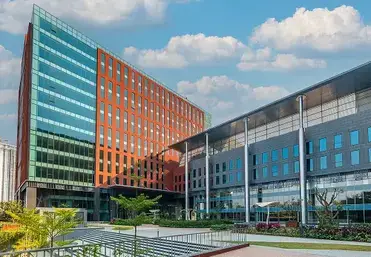
Brigade Tech Park is a commercial development in Whitefield, Bengaluru, one of the city’s established technology corridors. Official project information describes it as a 4-acre development with approximately 440,000 sq. ft. of built-up area, Basement + Ground + 9 floors and flexible floor plates of 14,000 to 50,000 sq. ft..
The project is located near a metro station at 0.5 km and Hope Farm Junction at 2 km. For occupiers and investors, Brigade Tech Park shows how location, flexible layouts, transport access and developer credibility can come together in a high-demand business district.
Conclusion
In 2026, office investment is being shaped by strong leasing, GCC expansion, flexible workspace demand and a continued preference for Grade A offices in well-connected business districts. Not all opportunities are equal. Income potential, asset value and liquidity depend on micro-market strength, lease terms, tenant quality, financing structure and property management.
For those evaluating India’s office market, the key is to connect macro trends with asset-level detail. Bengaluru, Hyderabad, Chennai, Kochi and other growth corridors will continue to draw attention, while the strongest opportunities will be anchored in future-ready workplaces, credible developers and ecosystems that help businesses expand with confidence.
FAQs
1. How do I choose the right location for an office investment?
Focus on talent access, metro and road connectivity, occupier demand, business district maturity, planned infrastructure and the presence of complementary commercial ecosystems.
2. What are the risks in commercial office investments?
Key risks include vacancy, tenant default, weak lease terms, refinancing pressure, title issues, liquidity constraints, high maintenance costs and changes in occupier demand.
3. Does Brigade Group offer property management for investors?
This depends on the specific building and agreement. Investors should verify what is included in tenanting, rent collection, common-area management, maintenance planning and reporting.
4. Can I invest in commercial office space without buying an entire building?
Yes. Investors may consider strata ownership, fractional platforms, REITs or listed real estate securities, subject to checks on regulation, title, liquidity, fees and investor protections.
5. Why do Grade A offices matter for GCCs?
GCCs typically need scalable floor plates, reliable infrastructure, compliance-ready operations, employee amenities and strong connectivity. Grade A offices are better aligned with these occupier expectations when supported by the right location and management quality.
Looking for Grade A Commercial Spaces Built for Long-Term Value?
Lease or invest in future-ready developments across Bengaluru, Chennai, Hyderabad, Kochi & GIFT City.
- Grade A commercial developments
- Prime business & IT hub locations
- Lease & investment opportunities
MUST READ






Looking for something specific?
We'd be delighted to help you.
