
Commercial
How to Transform Empty Office Space and Maximise Revenue
August 18, 2026
Turning empty office space into revenue starts with subleasing, converting it to a coworking or managed workspace model, or arranging a sale-leaseback — options that generate direct income rather than sitting idle. It can also be rented out by the desk, hour or event, or repurposed for hot desking, wellness or training use when income isn't the priority. For large or long-vacant spaces, partnering with a commercial developer to redevelop or reposition the asset often works better than piecemeal fixes.
Work has changed. Hybrid schedules and remote-first policies mean a lot of office space that used to be full most days now sits empty most of the week. If you can't easily sell that space, or don't want to, an empty office is a cost with no return — rent, maintenance and utilities keep running whether anyone's using the space or not.
The good news is there's more than one way to turn that into an asset again. Some options generate direct income. Others make better use of the space without necessarily monetising it. Here's how to think through both.
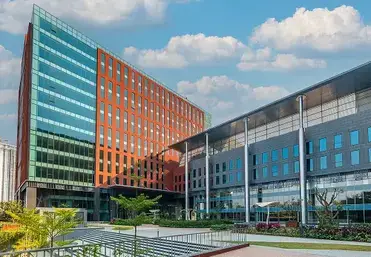
Brigade Square is Brigade Group's commercial development in Technopark Phase 1, Trivandrum — India's first and largest IT park. Spread across 1 acre, this 2B+G+12 Grade-A office building offers a total built-up area of 1,85,613 sq. ft., with typical floor plates of around 14,000 sq. ft.
Designed by Rajinder Kumar Associates, Brigade Square overlooks lush green tropical forest and is built to make the most of natural sun, wind and the surrounding ecosystem — an environmentally responsible campus rather than a purely functional office block.
Revenue-Generating Ways to Use Empty Office Space
Sublease or Rent Out the Space
If you hold a long lease or own the space outright, subleasing part or all of it to another business is often the simplest way to turn a cost centre back into income. It keeps the space occupied and maintained, and gives you a steady, predictable cash flow instead of an ongoing expense.
Convert to a Coworking or Managed Workspace Model
Partnering with a managed workspace or coworking operator lets you monetise unused floors without managing tenants directly — the operator handles leasing, fit-out and day-to-day operations, and you earn from the arrangement. This model has grown fast as more companies, including Global Capability Centres, look for managed office space that's ready to scale up or down quickly.
Explore a Sale-Leaseback Arrangement
If you own the building and want to release capital without giving up the space entirely, a sale-leaseback lets you sell the property to an investor and lease it back for continued use. This converts a fixed asset into liquid capital while keeping your operations in place — worth exploring if the goal is funding growth elsewhere rather than exiting the space.
Rent by the Desk, Hour or Event
Not every business wants a long-term tenant. Renting out desks on a daily or monthly basis, or the whole space by the hour for meetings, workshops or corporate events, can generate income from space that would otherwise sit idle between full-time uses.
Repurposing Empty Office Space (Beyond Direct Income)
Hot Desking
Hot desking means no desk is permanently assigned to any one employee — anyone can work wherever they like when they're in. It suits hybrid teams well, since it uses less space overall while still giving people flexibility and room to collaborate.
Employee Wellness Space
Empty space can become a wellness area — think showers for cyclists and runners, a quiet room, or space for occasional yoga or wellness sessions. It's a genuine perk for employees who do come in, and it can support the case for bringing more people back to the office voluntarily.
Professional Development and Training
If your team works remotely most of the time, use the freed-up space for training sessions, workshops or team collaboration days — occasions worth bringing people in for, rather than everyday desk space.
Recreational and Networking Space
Converting part of the office into a casual, recreational area gives employees a reason to stay and connect with colleagues, and can double as a space for informal networking events with people outside the company.
Pop-Up Events
A short-term pop-up — a few hours to a few days — is a low-commitment way to use empty space occasionally, whether that's a playground event for employees' families or a one-off networking session.
When It Makes Sense to Work with a Developer
For a single underused floor, the ideas above are usually enough. But if a large space has sat empty for a long time, or the building itself no longer fits how your business works, it may be worth stepping back and asking whether redevelopment or a full lease restructure makes more sense than a partial fix.
This is where working with an established commercial developer helps — from restructuring an existing lease to finding the right tenant profile for a large space. Brigade's hassle-free office leasing model is built around exactly this kind of flexibility, and our guide on how to lease office space in India walks through the process end to end if you're weighing your options.
Tip: Before committing to any option, check your lease terms for restrictions on subletting or change of use — some leases require landlord approval before you can bring in a subtenant or coworking operator.
Making the Right Call for Your Space
There's no single right answer — it depends on whether you own or lease, how long the space is likely to stay underused, and whether your priority is steady income or better use of the space you already have. If you're evaluating options in Bengaluru, Chennai or Hyderabad, explore Brigade's commercial spaces in Bengaluru, Chennai or Hyderabad to see what a professionally managed commercial portfolio looks like in practice.
FAQs
1. How can I make money from empty office space?
The most direct ways are subleasing to another business, converting to a coworking or managed workspace model, renting by the desk or hour, or exploring a sale-leaseback if you own the property.
2. What is a sale-leaseback and how does it work?
A sale-leaseback is when you sell a property you own to an investor and then lease it back for continued use. It converts a fixed asset into liquid capital while letting you keep operating from the same space.
3. What is hot desking?
Hot desking is an office setup where no desk is assigned to a specific employee — anyone can use any available desk when they're in the office. It works well for hybrid teams that don't need everyone in at once.
4. Should I sell or lease my vacant office space?
It depends on your goals. Leasing (or subleasing) gives you steady income while you retain ownership; selling — including via sale-leaseback — releases capital upfront. If the space is core to your long-term plans, leasing usually makes more sense; if you need capital elsewhere, selling might.
5. How do I find tenants for vacant office space quickly?
Working with an established commercial developer or leasing partner is usually faster than doing it independently, since they already have tenant networks and market knowledge. Listing through a managed workspace operator can also fill space faster than a traditional long-term lease search.
6. Can empty office space be converted to a different use, like retail?
In some cases, yes — but it depends on your lease terms, local zoning rules and building approvals. Always check for restrictions on change of use before committing, since converting from office to retail or another category often needs landlord and municipal sign-off.
Looking for Grade A Commercial Spaces Built for Long-Term Value?
Lease or invest in future-ready developments across Bengaluru, Chennai, Hyderabad, Kochi & GIFT City.
- Grade A commercial developments
- Prime business & IT hub locations
- Lease & investment opportunities
MUST READ





Looking for something specific?
We'd be delighted to help you.
