Residential
How to Increase Your CIBIL Score for Home Loan Application
July 24, 2017
A CIBIL score is a 3-digit number between 300 and 900 that reflects your credit history and repayment behaviour — the higher the score, the more confidence a lender has in you. For a home loan, most lenders look for a score of 700-750 or above, with anything past 750 unlocking the best interest rates. Five factors shape it: payment history, credit utilisation, credit mix, credit age and loan enquiries. This guide also covers practical steps NRIs can take to build or strengthen their CIBIL score before applying for a home loan in India.
Owning a home is a big goal, and a home loan is usually how most people get there. A number of factors go into whether your application is approved, and your CIBIL score is one of the most important.
Your CIBIL score — also called your Credit Information Bureau (India) Limited score, or simply your credit score — reflects your credit history. You build and maintain a good score mainly by paying your dues on time and avoiding late payments.
What Is a CIBIL Score, Exactly?
CIBIL — TransUnion CIBIL, to give its full name — is one of four credit information companies licensed by the Reserve Bank of India (RBI). It tracks the credit histories of hundreds of millions of individuals and businesses across India, and compiles that history into a 3-digit score between 300 and 900. The higher your score, the more confidence a lender has that you'll repay on time.
What Is a Good CIBIL Score for a Home Loan?
| CIBIL Score Range | Rating | What It Means for a Home Loan |
|---|---|---|
| 300 – 599 | Poor | Approval very unlikely from most lenders. |
| 600 – 699 | Fair | Some lenders may approve, often at higher interest rates. |
| 700 – 749 | Good | Meets the minimum most lenders want for home loans. |
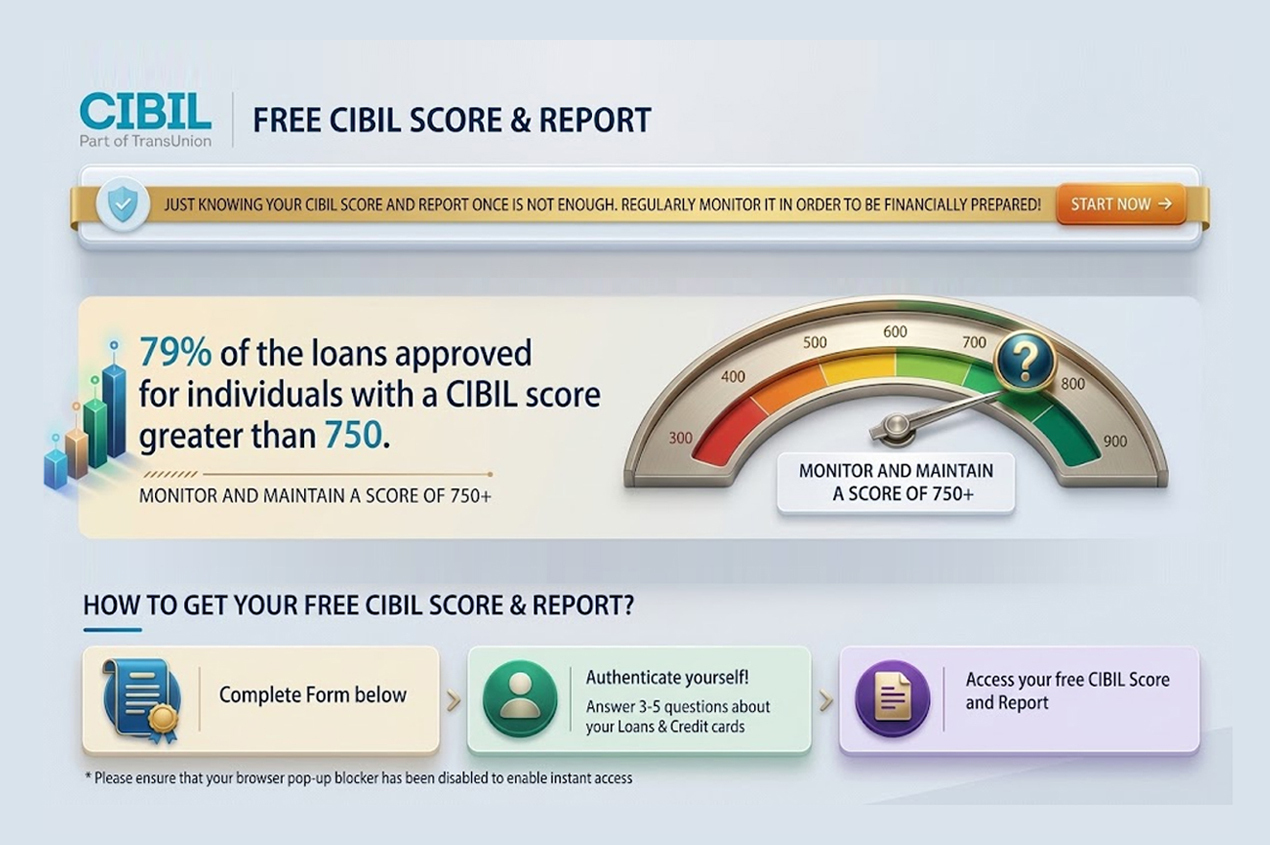
| 750 – 900 | Excellent | Best approval odds and the most competitive interest rates. |
Tip: Most lenders look for a CIBIL score of 700-750 or higher for a home loan. A score above 750 typically gets you both easier approval and a better interest rate — even a small rate difference adds up significantly over a 15-20 year loan tenure.
5 Factors That Affect Your CIBIL Score
- Payment history: Paying EMIs and credit card bills on time is the single biggest factor. Even one missed payment can pull your score down.
- Credit utilisation: Try to use less than 30% of your available credit limit. Maxing out your credit card regularly signals financial stress to lenders.
- Credit mix: A healthy balance of secured loans (like a home or car loan) and unsecured credit (like a credit card) is viewed more favourably than relying only on unsecured debt.
- Credit age: A longer credit history with consistent, on-time repayment strengthens your score over time — this is one reason closing your oldest credit card isn't always a good idea.
- Loan enquiries: Every loan or credit card application triggers a "hard enquiry." Too many in a short period can lower your score, even if you're not approved.
How to Increase Your CIBIL Score
Pay Your Dues on Time
This is the single most effective thing you can do. Automating your payments so dues are cleared before your other monthly expenses is a simple way to make sure you never miss one.
Check Your Outstanding Credit
Your CIBIL score reflects how consistently you've paid down what you owe. Review any pending credit, spot patterns in your repayment behaviour, and regularise anything that's slipping.
Build Enough Credit History
If you've never taken a loan or used a credit card, you may have too little credit history for a strong score. Applying for a credit card and using it responsibly, with timely payments, is a reasonable way to start building one.
Understand Secured vs Unsecured Loans
Secured loans — like home loans or car loans — are backed by collateral and, when paid on time, tend to strengthen your score. Unsecured loans — personal loans, credit cards — carry more weight against you when there's too much of them outstanding.
Use Your Credit Card Wisely
Stay within your credit limit rather than overspending and asking for extensions later. And always pay by the due date — even a short delay can trigger interest charges and hurt your score.
Don't Apply for Too Many Loans at Once
Multiple loan or credit card applications in a short window signal risk to lenders. Space out your applications, and if you've been rejected once, focus on improving your score before trying again rather than approaching a different bank immediately.
Check Your Score Regularly
Many banks, NBFCs and financial apps now offer free CIBIL score checks — you no longer need to pay a fee for a basic check. Checking your score two to three times a year helps you catch errors early; if you spot a discrepancy, raise it with CIBIL or your bank promptly.
CIBIL Score Tips for NRIs Applying for a Home Loan in India
- NRIs do get a CIBIL score if they've held any Indian credit product — a credit card, loan, or even a mobile/utility connection linked to PAN — so check your score before assuming you don't have one.
- If you have little or no Indian credit history, an NRE/NRO-linked credit card used responsibly for a few months can help establish one before you apply.
- Keep your PAN, address and contact details updated with Indian banks — mismatched records are a common reason NRI CIBIL reports show gaps or errors.
Most Indian lenders apply the same 700-750 minimum threshold to NRI applicants as resident Indians, though documentation requirements differ. Brigade's NRI Corner offers dedicated guidance on financing and documentation for NRIs buying property in Bengaluru, Chennai or Hyderabad, including how Indian lenders evaluate NRI applications.
In Summary
A strong CIBIL score significantly improves your chances of home loan approval and gets you better interest rates — it's one of the most important factors, even if not the only one lenders weigh. Follow the steps above consistently, and give your score time to reflect the change. Once you're loan-ready, explore Brigade's residential projects across Bengaluru, Chennai and Hyderabad, or read our tips for first-time home buyers in India for the rest of the home-buying checklist.
FAQs
1. What is the full form of CIBIL score?
CIBIL stands for Credit Information Bureau (India) Limited. It's now part of TransUnion, so scores are sometimes called TransUnion CIBIL scores.
2. What is a good CIBIL score for a home loan?
Most lenders look for a CIBIL score of 700-750 or higher for home loan approval. A score above 750 is considered excellent and typically gets you the most competitive interest rates.
3. Is 750 a good CIBIL score?
Yes. A 750 CIBIL score falls in the "excellent" range and generally gives you strong approval odds along with access to better interest rates on home loans and other credit products.
4. How can I check my CIBIL score for free?
Many banks, NBFCs and financial apps now offer free CIBIL score checks — you no longer need to pay a fee for a basic score check. It's worth checking two to three times a year to catch any errors early.
5. Can taking a home loan improve my CIBIL score?
Yes, over time. A home loan is a secured loan, and consistent, on-time EMI payments on it can strengthen your credit mix and repayment history, both of which positively affect your score.
6. Is CIBIL score the only factor considered for home loan approval?
No. While your CIBIL score is one of the most important factors, lenders also weigh your income, employment stability, existing liabilities (debt-to-income ratio), and the property being financed.
7. How can NRIs improve their CIBIL score before applying for a home loan in India?
NRIs can build or improve their CIBIL score by using an NRE/NRO-linked credit card responsibly, keeping PAN and contact details updated with Indian banks, and checking their score to catch and correct errors before applying.
8. How long does it take to improve a CIBIL score?
There's no fixed timeline — it depends on your starting point and how consistently you improve your repayment behaviour, but most people see meaningful movement within 6-12 months of consistent, on-time payments and lower credit utilisation.
MUST READ






Looking for something specific?
We'd be delighted to help you.
